Monday, May 21, 2007

The Century of Humiliation Atlas

I had a request not too long ago for more maps on the site. So here are some images of the Chinese Century of Humiliation Atlas, available at this 163 forum. You can read a good analysis of the atlas and the role of humiliation in the official interpretation of Chinese history in this PDF "National Insecurities: Humiliation, Salvation and Chinese Nationalism". This book may only be 11 yuan online, and probably not widely read in urban and middle class circles, but it is on a list of 2,090 titles recommended for 1,550 rural farmers libraries by the Central Propaganda Ministry.

The Cover

Imperialism in 1840

The "Century of Humiliation" refers to the 100+ years from the First Opium War in 1840 to the founding of the People's Republic of China in 1949. While the phrase isn't exactly part of normal conversation these days, it certainly is still in use. An online martyrs memorial website, 血铸中华, or "Blood Casting Chinese"(?), uses the URL http://www.china1840-1949.net.cn/ has a redirect to its main domain name, which is http://xzzh.china5000.cn/, which uses the more well-known reference to China's 5000 year history. The site is run by the China Youth League (Hu Jintao's power base) and the Chinese Academy of Social Sciences. The introduction at the top of the window, which is not entirely visible, reads
China's Online Revolutionary Memorial and Modern History Museum! Forever Remembering the Modern Century's Countless Chinese Sons and Daughters for Resisting the Imperialist Great Powers Invasion, Fighting for National Independence, and Indomitable Struggle towards Liberation, to Achieve the Chinese People's Great Rejuvenation! Forever Remember the Chinese Heroes Great Service!
China's Once and Future Glory

The First Opium War Invasion Routes

It's worth remembering that virulent nationalism is not pandemic across China, the idea of China's humiliating fall (and subsequent picking itself off the ground - this corollary was the subtext of the documentary The Great Nations) is almost universally accepted, and did not begin with the Communist era. It stretches back to the end of the Qing Dynasty, as reformist Hanscholars quickly sought to interpret Chinese defeat in the Opium War as a sign of a decadent and failing Manchu court - a political battle for power between factions in the government. The Republican era embraced the idea as well, and even had a National Humiliation Day (I believe May 7th). It's also worth remembering that China sees it's own "modern era" as beginning with humiliation - the idea of being "modern" is deeply intertwined with being humiliated and weak. One would hope that one day this might change.

Imperialist Routes into China

Japanese Manchuria
Lost Territory

Saturday, May 19, 2007

Lung Yingtai Waves About Meaningless Statistics, Declares Sovereignty of Sealand

I certainly enjoyed Lung Yingtai's intellectual brawler style when she wrote "The Taiwan That You May Not Know About" for the infamous China Youth Daily supplement Freezing Point, whose editor wrote another classic about the fallout of that and other articles entitled "It's Lung Yingtai again, f**k!". And who could forget her open letter to Hu Jintao, "Please Use Civilization to Convince Us". She's said quite openly that "As a matter of fact, I am just someone who refuses to believe that human rights must not be distinguished by political position. The Nationalist Party, the Communist Party, the Democratic Progressive Party, whatever f*cking party, if human dignity is not your core value and if you permit human rights to be determined by the powers-that-be, then you are just an object upon which I spit. You do not intimidate me", and, in probably my favorite, compared the reductionist idea of "Asian values" to a pool of dead water.

But I totally think she's been phoning it in lately. In a speech at Cambridge this past week (the bulk of which she's been repeating since December 2006), entitled "If You Want Peace, You Must Not Keep Hurting Taiwan", Lung used some pretty lazy rhetorical devices. Moreover, her argument essentially seems to be that to be denied a nation-state is a violation of one's human rights, which strikes me as ludicrously problematic.

The first thing that really caught my eye was this:

The 23 million people in Taiwan went through a martial law period of 37 years. Martial law meant a form of siege. After the martial law period, there was another 35 years of international blockade up to now. After 37 years of martial law and 35 years of blockage, there has to be some "symptoms." In 2006, the survey results from a certain Taiwan magazine are astonishing.

  • 80% of the Taiwanese do not know where the United Nations headquarters is located
  • 80% of the people do not know in which city the Nobel Prize for Literature is awarded
  • 80% of the people do not know where the largest rainforest in the world is located
  • 60% of the people do not know the name of the currency in Germany
  • 60% of the people do not know which continent Athens is located in

You should not think that this survey was conducted in some remote village. No, the principal sample came from Taipei, and the people of Taipei are supposed to have the highest educational level in the Chinese world.

Alright then. So the results of this survey are intended to prove the dire consequences of "international blockade" of Taiwan, dating back to the handover of Taiwan's UN seat to the PRC. Lung is claiming that Taiwan's lack of membership to this and many other international bodies has created "cultural isolation", resulting in a very geographically-challenged citizenry.

First off, there's nothing in Lung's argument showing how one ("isolation") causes the other (poor geography skills). Second, my girlfriend and I are university educated, European and American respectively, and have traveled to well over a dozen countries each - and both of us blanked on what city hosts the Nobel. Third, I'm guessing Lung has never watched Jay Leno's "Man on the Street" bits on American TV, nor has she seen the 2006 National Geographic-Roper Survey of Geographic Literacy, which demonstrated that embarassingly high numbers of young Americans, even amongst college graduates, could find neither Iraq nor Louisiana on a map. Or the Pew Research Center's 2007 report on American political knowledge indicating that 64% of respondents couldn't name the president of Russia, or my personal favorite, that over 70% of Americans didn't know plastic was made of petroleum. The United States belongs to all of the international bodies that Taiwan's absence from, according to Lung, leads to bone-headed ignorance, but membership hasn't made us any better informed.

But apparently the Taiwanese peoples complete and total inability to survive even one round of quiz night in a British pub, or an opening round of the American TV show Jeopardy!, is proof positive of how damaging the 35 year old "blockade" of Taiwan by cold, indifferent foreign nations has been. I am not saying that this means Taiwan shouldn't be recognized; I'm simply saying that if Lung is going to use this sort of argument in addressing Western audiences, she must take us for idiots (as the above mentioned statistics would prove, so I guess she's on the right track).

Even worse, I don't think Lung is mentioning everything the Taiwanese survey in question discovered. My guess is that Lung was looking at a 2004, not 2006, survey by Taiwan's Commonwealth Magazine (天下), the findings of which are shown on this blog (in Chinese) and match all of Lung's cited figures and questions. But the survey also says that 60% of Taiwanese respondents have been abroad, 45% have been to two or more countries, and 40% speak two or more foreign languages. This is an odd sort of "isolation" - not alot of countries can claim to be that well-traveled or multilingual. Even if it only means everybody speaks English and has been to Disneyland, that's way more than most of the world. Taiwan is also one of the most wired countries in the world, with something like 63% of the population having Internet access, and over 70% or so having a PC in the home. No Great Firewall to boot, I'd add.

I find Lung Yingtai's argument that national sovereignty is some sort of human right more problematic. She states:
"Perhaps you wonder, Is there a human rights problem with Taiwan?

Put it this way -- suppose we have a small community here. For what reasons do we have to not permit the people from this community to attend any conference or participate in any decisions. We do not allow them to appear at any important festive, mourning or memorial functions. Furthermore, we forbid the leaders of this community to step out of their community and enter our area. Worse yet, if there is a huge fire, we will not notify them. We don't even allow them to call themselves by their own name.

Please ask yourselves: Why is this not a violation of human rights?"

Well, my first thought is that what she's talking about here is not that people from the community are forbidden to do these things - its representatives of the government of Taiwan that are forbidden. Now that might be unfair or wrong, but last I checked human rights are not extended to governments or nation-states, which is what she really saying. She then gives concrete examples, more or less, such as that Taiwan doesn't belong to international bodies and Chen Shuibian has trouble getting visas. Fair enough, but again I don't know if this qualifies as a human rights issue. An issue, certainly, but human rights? That's tricky. I would be curious to hear Lung Yingtai (or anybody's) thoughts on Article 15 of the Declaration of Human Rights stating everyone is entitled to a nationality - what on Earth does that mean? Which nationality, who chooses? If you can choose, does that mean we have to give all those micronations seats at the UN too? By Lung Yingtai's argument, the community of Sealand has their human rights violated because they too are not represented in the UN. And what about Taiwanese Aborigines, while we're at it?

But her other examples are worse. She then proclaims "The international community knows about the political isolation of Taiwan. But I think that the international community has no awareness whatsoever about the depth and breadth of this isolation and the degree of damage done to the people of Taiwan." The survey mentioned above is given as "astonishing" proof of this. Another example is "Using art an example, Taiwan cannot be represented in the public national museum venue at the Venice Art Exposition. Instead, it must find another venue for which it has to worry about being able to retain for the next year." I assume that Lung is referring to the Venice Biennale, where actually alot of countries don't get to be in the national museum, the Giardini. The PRC isn't in it either, or Hong Kong or Macao, which also have separate venues, or Portugal, Argentina, Turkey or quite a few others. All of Africa is shoved into one pavilion, while Central Asia is crammed in another. The PRC has only been there a few years, with a SARS interruption, while Taiwan appears to have been ensconced quite safely since 1995 in the Palazzo delle Prigione, where it is again situated this year, and for the foreseeable future. It's also amusing to note that in 2003, the "isolated" Taiwanese artists shown all lived abroad save for one, though selected by curators and artists in Taiwan. The curator Lin Shu-min noted, "Where you are doesn't really affect your cultural roots". I wonder what Lung Yingtai would make of that remark.

Back to the quote I gave in the beginning and Lung's thinking on human rights:

"As a matter of fact, I am just someone who refuses to believe that human rights must not be distinguished by political position. The Nationalist Party, the Communist Party, the Democratic Progressive Party, whatever f*cking party, if human dignity is not your core value and if you permit human rights to be determined by the powers-that-be, then you are just an object upon which I spit. You do not intimidate me"

Spitting, cursing and bravado aside, what does it mean for human rights to be independent of political position? How can one say that and simultaneously say that recognition as a nation-state, a purely political notion, is a human right? How would one apply this to any civil war or territorial dispute? If recognition of national sovereignty is a human right, then who gets Jerusalem? The answer appears to be whoever Lung Yingtai thinks really, truly holds "human dignity" as a "core value", because I can't see who else the arbiter is supposed to be.

Friday, May 18, 2007

An Alternative History of Chinese Scifi (and Barbershops)

I mentioned Jess Nevins before in the Thinking Blogs meme. A librarian of pulp fiction, he pointed me towards some great stuff on Late Qing Dynasty scifi/fantasy writing. Now he has a helluva thought experiment up: An Alternative History of Chinese Science Fiction. Quibbling aside, its fun. Oh, and these fictitious alternate Chinese versions of famous science fiction novels occur in a world where Chen Shuibian is president of China because the Communists lost.

And I wanna give a shout-out to Ben's Blog, where Ben Ross, ethnographer, is blogging pretty much daily about working as a hair-wash guy in a Chinese barbershop for a month. Fan-f**king-tastic. Oh, and he's in Fujian, so he gets extra cool points for that, though Northern Fujian ain't as good as Southern. I'm just sayin'.

Monday, May 14, 2007

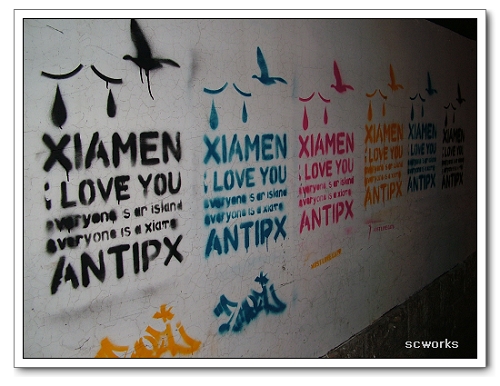
厦门加油!ANTI-PX Graffiti in Xiamen!

Read the background in this post here. Here's the blog of the guy who did it. Photo courtesy of this blogger, thanks to Chinese blog equivalent of the Superfriends, Memedia.

Goddammit, why do I always run into this stuff just when I'm leaving town for a couple of days???

Sunday, May 13, 2007

Chinese Search Censorship? Just SoSo


Word has it that Tencent, makers of the Chinese chat and currency juggernaut QQ, has a new search engine that might be a strong rival for Baidu and Google. The search engine, called SoSo 搜搜, may be well placed since the hundreds of millions of QQ users in China would be drawn to it, but on the other hand it uses licensed Google technology, so we'll see. But more importantly, SoSo is, well, so-so on censorship. Maybe you need a noticeable market share before the net cops show up?

Writing A Time 100 Profile: No Experience Necessary

Arianna enjoys wuxia cosplay in her free time

Shorter Arianna Huffington:
  • I can't read Chinese, and don't know anything about Tiananmen, but no one will know if I don't give a link or translations of ZYJ's blog. Also, cliched rhetoric is bad if you're George Bush, but it's perfectly fine for summarizing China. And maybe Tank Man was someone else, but that would screw up my conclusion that I arrived at without knowing what I'm talking about in the first place.
Shorter Time 100 Editorial Board:
  • All bloggers are the same, so let's just get some known US blogger to review these crazy chicken scratchings. Michelle Malkin's Asian, isn't she? Oh, she's busy? Um, Greece Los Angeles is like China, isn't it? I think Arianna's been to Koreatown...
‘Shorter’ concept created by Daniel Davies, perfected by Elton Beard, and used regularly by SadlyNo!.

Saturday, May 12, 2007

MySpace Censors Say "Sorry for the Inconvenience"?

First off, it looks like my guess that MySpace.com is blocked in China is right. At least, Shanghaiist and their commenters are seeing it too. It's suspicious that MySpace.com would be blocked soon after the launch of MySpace.cn. Dot-com has been available, more or less, for a while, and a fair number of savvy Chinese users created accounts at MySpace.com, such as punk bands. Now, right after the launch of MySpace.cn, they're all forced to migrate over to .cn - a sudden leap, assuming they keep using MySpace, in registration and pageviews. Otherwise, the government said "Right, so let's narrow this channel a bit".

That's not the only narrowing though. I've been playing around with some verboten words on MySpace.cn for a while. Some terms, particularly in Chinese, get blocked by the GFW presumably at the router level - before they ever reach MySpace.cn. Unlike Google.cn, though, the search results look the same (so far) if that doesn't happen. But I've been encountering what is beginning to look suspiciously like censorship: The "Page Under Going Maintenance" sign.

The "Undergoing Maintenance" sign appears when you open a profile that is, well, undergoing maintenance. You see it in MySpace.com sometimes, it's normal enough. Some pages that contain verboten topics open just fine, others have consistently been other maintenance. One thing about MySpace.cn, though, is that it completely duplicates accounts across international MySpace. In other words, if you take a profile link, say:

http://profile.myspace.cn/index.cfm?fuseaction=user.viewprofile&friendid=125043500

and change it to:

http://profile.myspace.com/index.cfm?fuseaction=user.viewprofile&friendid=125043500

You're looking at the same persons page, just that the menu bar and template change languages. The example above is a page with alot of censorship no-nos in it. The .com version opens fine (with proxy in China, w/o in most other nations). The .cn version gives you "This page is undergoing maintenance. If this is inconvenient, we're very sorry!"

Which wouldn't mean much except it seems to happen to a fair number of verboten pages. Not all, but many. It's hard to test them all from China since I now have to proxy the .com pages and it's slow as molasses sometimes. So here's a list of some "maintenanced" pages that I haven't checked in MySpace.com:

http://profile.myspace.com/index.cfm?fuseaction=user.viewprofile&friendid=135332659
http://profile.myspace.com/index.cfm?fuseaction=user.viewprofile&friendid=122628624
http://profile.myspace.com/index.cfm?fuseaction=user.viewprofile&friendID=17397486
http://profile.myspace.com/index.cfm?fuseaction=user.viewprofile&friendid=170257091

On the other hand, there's plenty of other things that get through. But the maintenance pages seem worth keeping an eye on...

Friday, May 11, 2007

China in Google Earth


The Unofficial Google Earth Blog has occasional goodies related to China:
Also, the Tsim Sha Tsui Clock Tower lives - as a 3D model.

Today's Moment of Cognitive Dissonance

I'm starting to enjoy MySpace.cn.

Thursday, May 10, 2007

MySpace.com Blocked?

A couple of weeks ago a vicious rumor spread through the Chinese Internet, according PCOnline (太平洋电脑网), reported access to Google.com had disappeared for some users. It wasn't true.

So in this grand tradition of spreading rumors, I say: MySpace.com may possibly perhaps be blocked. Visual Traceroute shows a failure to connect beyond CHINANET Shanghai. Through May 8th, MySpace.cn reported that 31,826 users registered. Redline China has determined there were over 41,000 registrations by May 9th based on MySpace.cn editor Wu Kong's friends list, since he is automatically friended to new registrants. This isn't terribly scientific, since Chinese users can delete him from their friends just like Tom. Tom, along with a number of other non-Chinese MySpace users, are also among Wukong's friends. Whatever the number, it doesn't seem to have impressed anybody yet.

It is still possible to access questionable profiles through MySpace.cn.

Wednesday, May 9, 2007

Tim Johnson, What Happened with Your Tibet Story?

In seems that one of our own, blogger Tim Johnson of China Rises, (as a side hobby he's the Beijing correspondent for the McClatchy Newspapers & Junk Bond Imperium/Emporium) has become the target of a vengeful source. Tim recently wrote a piece entitled "China Orders Resettlement of Thousands of Tibetans", and a Case Western professor of Tibetan Studies, who appears in the article, feels he has been misquoted. Here's the relevant bits of Tim's piece. First, the nut graf:
ZENGSHOL, Tibet - In a massive campaign that recalls the socialist engineering of an earlier era, the Chinese government has relocated some 250,000 Tibetans - nearly one-tenth of the population - from scattered rural hamlets to new "socialist villages," ordering them to build new housing largely at their own expense and without their consent.
Indeed. Very concerning. Here's his quotes of one Professor Melvyn Goldstein of the Center for Research on Tibet at Case Western University:
""It's created a building boom," said Melvyn C. Goldstein, a social anthropologist and expert on Tibet at Case Western Reserve University in Cleveland. "I think it's phenomenally successful, more than I would've believed.""
This is followed by a bit about how Human Rights Watch paints a bleaker picture. Then Goldstein is cited again at the end of the article:
"Goldstein noted that the settling of Han Chinese in Tibet's major cities already has weakened the influence of traditional Tibetan elites. "The cities are a loss," said Goldstein, referring to demography from a Tibetan point of view. "The last hope is to keep the villages intact. If there's a battleground for Tibetan identity, it's in the rural areas.""
When I first read this article, the first thing that leapt out at me was that it reminded me of alot of the ethnonationalism that permeates discussions of Tibet. The article says that the relocation recalls the massive social engineering of an earlier era - but wasn't it just a few years ago that Peter Hessler wrote in Time Magazine, as did many others, about the forced relocation of Chinese along the Yangtze for the Three Gorges Dam? And didn't that also mean rural villagers had to give up their way of life - their identity, as Johnson points out Tibetan identity is threatened by relocation? Yet Johnson's article frames this as a unique crime being perpetrated against one ethnic group in China - Tibetans - using extraordinary measures that have not been used since "an earlier era", even though less than a decade ago the complaint du jour about China, the catastrophe of the Three Gorges, involved the same problems and Han Chinese citizens? Here, I felt, was the same tired ethnically biased narrative we see about Tibet: the Tibetans suffer in extra-special ways compared to Han Chinese. I am willing to consider that more Tibetans are imprisoned, tortured, denied opportunities and face other forms of severe discrimination. I lived in Xinjiang, and the Uyghurs certainly do. But rarely does anything written about Tibet remark that Han Chinese often suffer the same problems - in fact, the tendency is to make Tibetans out as an isolated and special case.

But before I could write about that, a reader at BoingBoing and acquaintance of Dr. Goldstein submitted Dr. Goldstein's response to Tim Johnson's article. And I want to take a moment to tip my hat to Xeni Jardin for posting that readers comment and also linking to my critique of BoingBoing and another post they had. Xeni called me thoughtful. My heart flutters.

Key points of Dr. Goldstein's complaint are:

1) he never said relocation was "phenomenally successful, more than I would've believed", as the article implies. He said "a marked increase in the standard of living as rural Tibetan families are participating more and more successfully in non-farm income producing jobs for part of the year."

2) "
Initially the government's idea was to have these new houses built along main roads, but this is not what is going on now in the areas we are conducting research in Shigatse prefecture," says Goldstein, though Johnson states the government "claims that the new housing on main roads".

3) Goldstein directly contests HRW's claim, repeated by Johnson, that "None of those interviewed reported being given the right to challenge or refuse participation in the campaign", when he wrote "Right now the villagers where we work have a 5 year window to decide whether to participate and rebuild". Both claims could be correct - Tibet has more than one village. But this was not addressed in the article.

4) While HRW claims that villagers must take out thousands of dollars in loans to rebuild, Goldstein describes loans on a sliding scale based on relative wealth and what sort of housing they choose to construct.

5) Goldstein concludes "
Consequently, as a result of this program. there is a building boom in rural areas that is affording rural Tibetans who are carpenters, stone masons, painters, and those who have tractors and trucks etc., increased access to non-farm income, and that is having a very positive impact on the overall standard of living. So in my view, this is a relatively benign program aimed at improving the quality of life and goes along with government interest in speeding up rural electrification, running water programs, etc. That is what I was trying to convey [in a previous interview]."

These quotes are all from an email Goldstein says he sent to Johnson before the article was published. Needless to say, it only furthers my belief that stories about Tibet are trimmed, folded, cut, bent and even broken in order to fit into the slot marked "Brutal Chinese Occupation of Tibet", because apparently that's the narrative it has to match. Any complications, grey areas, inconsistencies or problems are elided. When that narrative is repeated so often, do you know how alot of Americans will read such articles? They won't. They skim it and say "Oh, dear, that Tibet is still suffering [like they did last week, last year, the year before that, ad infinitum]... what's on the sports page?" And they won't learn anything new.

As for Dr. Goldstein's anger at being misquoted, I would suggest considering 1) reporters have editors who sometimes don't know Tibet from a six-limbed starfish, 2) reporters have deadlines, and 3) remember Brad DeLong and Susan Rasky's First Rule for Sources: Know Your Customers. The interviewee sets the rules, not the journalist. You can always decline to be quoted.

UPDATE: I contacted Tim Johnson about his article. He declined to comment and stands by the article. Fair enough.

Thursday, May 3, 2007

XKCD Map of the Internet - China Expansion Pack

中国在那里?

Boing Boing linked to this popular "Map of the Internet" at XKCD. I noticed the Chinese Internet wasn't represented, and XKCD's map is on a Creative Commons license, so I decided to make an expansion. I think I got the relative membership of Sina, Sohu and QQ, but I guesstimated on the BBSes (Tianya, Netease), and made up the video sites like Tudou and 6rooms. I realize there is enormous overlap between users on Chinese websites, but then again, the same goes for MySpace and the other services on the other side. If anybody has some better numbers on users, let me know - or copy it and make your own. I'd love to make this more detailed, but after drawing the Great Firewall I was exhausted and I'm going out in five minutes. Anyway, the point being the Chinese Internet gets left out sometimes even though its fairly big.

Gmail.cn Dead?


Gmail.cn did not respond to pings today. Neither does its parent ISM Technologies. WHOIS still declares Gmail.cn's status to be "OK".

Huh.

Wednesday, May 2, 2007

Empire of Lies - Thank God for the SCMP!

So China Digital Times pointed out that Guy Sorman, professional China-doubter (or basher, depending where you stand), has a new article in City Journal titled Empire of Lies. Well, I'm glad Sorman decided to use a calm, measured tone for his article. I find it deeply ironic that the article was also printed in Frontpagemag.com, not exactly known for truth-telling.

I can't argue with Sorman's point that China has some enormous problems, and I'm sick and tired as well of the whole "China's Century" meme. But some of the articles points just make me shake my head, for example:
  • On the Hong Kong press, in an insert by Howard Husock: "Their press is free and delightfully rich, ranging from the New York Post-ish Apple Daily to the historic English-language South China Morning Post, one of the best sources of information about Chinese politics." The SCMP is one of the best sources of information about Chinese politics? Not unless Hu Jintao is a horse. Considering 1) its online irrelevance, 2) that it reported Donald Tsang's election appointment with the headline "Incumbent Reflects on a Wonderful Journey" while ignoring protesters of the sort Sorman considers important, not to mention 3) the humorless drama that was Mark L. Clifford's tenure, or 4) the accusation that owner Robert Kuok is loyal to the CCP and that journalists Willy Lo Lam and Jasper Becker were fired for political reasons, this is a little hard to swallow. SCMP has been moving further and further into the sort of wealthy Asia expat press that caters in fat real estate listings and racetrack scores. Press freedom is certainly better in Hong Kong, and the SCMP does still have hardworking reporters, but I can't help but think anyone who believes the SCMP is at the cutting edge is, well, reading the wrong paper. Oh, and I have been told that Apple Daily is to the New York Post as apples are to...
  • "peasants, unfamiliar with the national language, speak only in regional dialects" - uh, ever heard of Cantonese, Shanghainese, Fujianese? These dialects are also spoken in cities. But hey, lets not argue with the government's implication that dialects are only for the backwards, uneducated and poor.
  • "The government puts the number of what it calls these “illegal” or “mass” incidents—and they’re occurring in the industrial suburbs, too—at 60,000 a year, doubtless underreporting them. Some experts think that the true figure is upward of 150,000 a year, and increasing. The uprisings are really mutinies, sporadic and unpremeditated. They express peasant families’ despair over the bleak future that awaits them and their children." Well, if you're gonna go with 60,000, that was the Chinese number in 2003 according to one of three different sets of mass incident statistics. And for none of those series is it clear whether a "mass incident" or "public disturbance" is a "mutiny". It may also include "delaying delivering of the mail". There's nothing to suggest that all of these are "mutinies", "sporadic" or "unmeditated". We don't know what they are.
  • "Were Western consumers and investors to turn away, the Chinese economy would collapse, leading in all probability to the fall of the Party." It's generally accepted the rest of the world would be kinda screwed as well.
  • "Yan Yfan underscores my fundamental error: “You don’t have any confidence in the Party’s ability to resolve the pertinent issues you have raised.” He’s right; I don’t." Fair enough, but one could stand to give the Chinese people a little credit. In Sorman's reading, Chinese people are either a) angry, voiceless peasants, b) Communist party parvenues or c) dissidents who are on "our" side. It reminds me of Jamie K's comment on "civic subhumanity" - if they're not with "us", they must be for "them".